Quiet Power for Productive Fall and Winter Projects
Running a workshop generator in a garage should not feel like standing next to a jackhammer. You want enough power to rip through plywood, charge battery packs, and keep lights bright, without rattling the house or waking up the whole block. That matters even more when the weather cools down and you spend more time working indoors.
As days get shorter in fall and winter, projects often shift to early mornings and late evenings. The house is quiet, kids might be sleeping, and neighbors are inside with their windows closed. In that setting, a loud generator can feel twice as annoying. The good news is, you can set up a workshop generator that gives you steady, safe power without turning your garage into a construction site soundtrack.
How Generator Noise Really Works in a Garage
To pick the right workshop generator, it helps to understand what the noise numbers really mean. Sound is measured in decibels, or dB. Normal conversation sits around the middle of that scale. A quiet generator might be close to that, while a loud, open-frame unit can jump far above it. Every jump of about 10 dB is heard as roughly twice as loud to our ears.
Garages and workshops are not kind to sound. Hard concrete floors, bare drywall, and exposed rafters all bounce noise around. Closed doors act like big drums. Even a modest generator that seems fine outdoors can feel much louder once you roll it into a tight, echoing space.
Cold weather makes this worse because we close everything up. When doors and windows stay shut, sound has fewer places to escape and more chances to bounce. Vibration from the generator can travel through the slab and into the attached house, so a loud unit in the garage can feel like a low rumble in the living room too.
To keep the noise under control, it helps to think about:
- Decibel ratings at different loads, not just at idle
- How close the generator will be to walls and doors
- How much the sound will bounce inside your particular garage
Choosing the Right Workshop Generator Type
There are two main categories for most small to mid-sized workshop generator setups: inverter generators and conventional open-frame units. Both can power tools, but they behave very differently.
Open-frame generators are the classic construction-style units. They usually make more noise, especially at higher loads. Inverter generators sit inside an enclosed case and use different electronics to clean up the power. This design tends to lower the sound level and make the power safer for laptops, battery chargers, and other sensitive gear you might use in a shop.
When you size a workshop generator, think about the tools you want to run at the same time. Common garage loads include:
- A table saw or miter saw
- An air compressor
- A small dust collector or shop vacuum
- LED shop lights and task lighting
- Tool battery chargers or a small benchtop machine
Each tool has two numbers: starting watts and running watts. Starting watts are higher and cover that first surge when a motor kicks on. Running watts are lower and cover the steady draw after the tool is already spinning. Your generator needs to handle the highest surge plus the running load of everything else you plan to use.
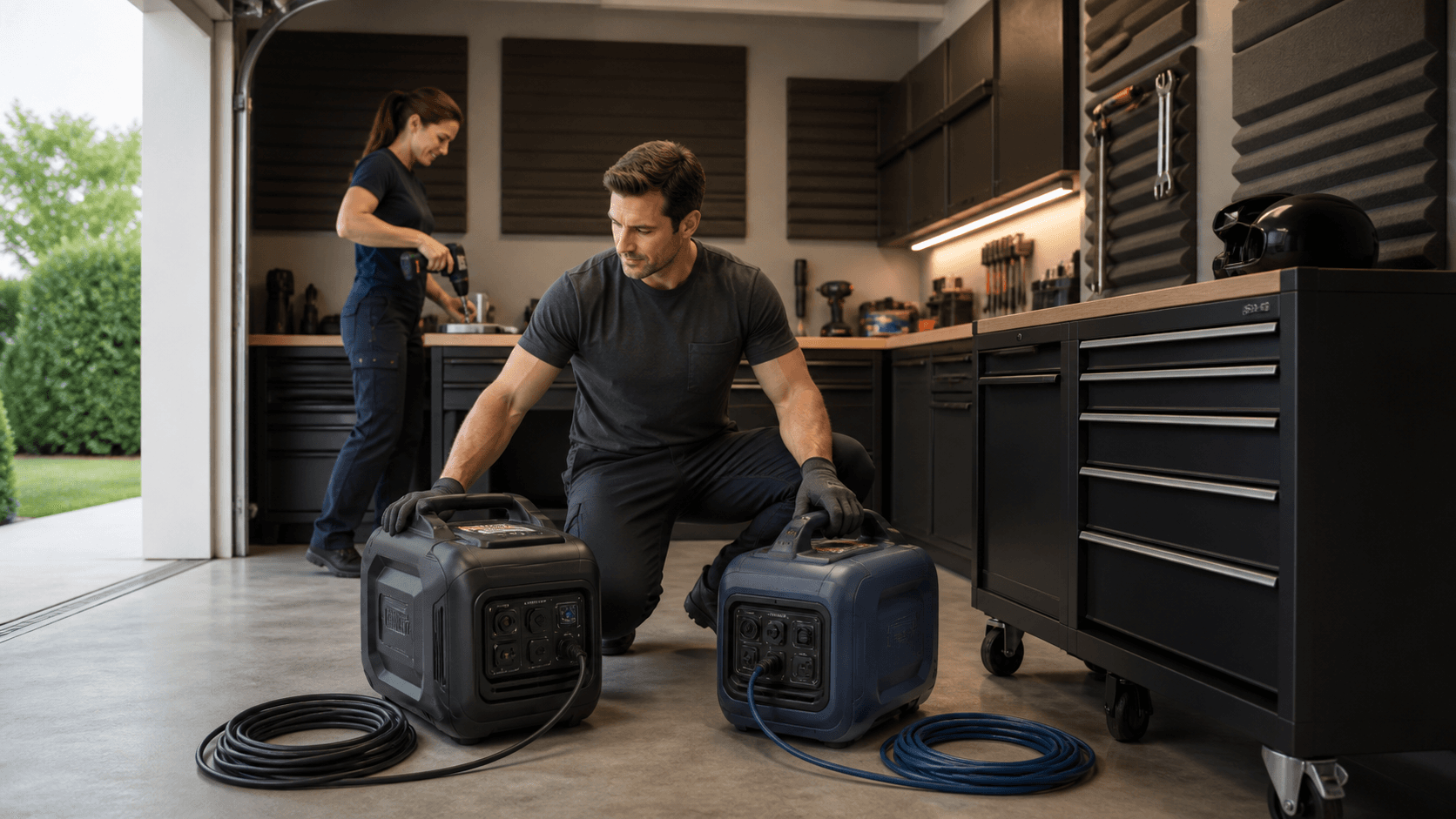
For noise-sensitive garages where tools, chargers, and maybe a small battery bank all share one power source, a quiet inverter-style workshop generator is often the best match. It gives smoother, cleaner power and usually includes features that keep noise down when you are not pulling full load.
Key Features That Keep Your Shop Quieter
When you compare models, do not just look at total watts. Pay close attention to sound and design details that matter in a garage.
Important noise-related specs include:
- Decibel rating at 25 percent load
- Decibel rating at 50 percent or rated load
- Eco or idle-down mode, which lowers engine speed when demand drops
Higher-quality inverter generators often list sound levels at a set distance. In a real workshop, your numbers might be a bit higher because walls bounce noise, but you can still compare models against each other.
Physical design also plays a big role:
- Fully enclosed housings that wrap the engine and muffler
- Rubber engine mounts that cut vibration into the floor
- A quality muffler and careful exhaust routing
- Controls placed so you can face the loudest side away from the work area
Smart setup adds another layer of quiet:
- Put the generator on a thick rubber or anti-fatigue mat to soak up vibration
- Use simple sound-absorbing panels or heavy shop items between the generator and your workbench
- Set it near an exterior door, with the loudest side turned out and away from walls
These small tweaks will not make a loud generator silent, but they can turn a reasonable unit into a much more pleasant shop partner.
Power Planning for Winter Storms and Shop Downtime
For many serious DIYers and shop owners, a workshop generator has a second job: backup power when storms roll through. If you pick the right size and type, one unit can handle both shop duty and emergency circuits.
Think about what you want to support during an outage:
- Basic lighting in key rooms
- Fridge or freezer
- Tool and device chargers
- A small space heater or oil-filled radiator in a safe area
At the same time, you may still want to run a couple of light-duty tools so projects do not grind to a halt. Load management becomes important. You might not be able to run a large heater, big compressor, and heavy saw all at once. Instead, you can rotate loads and shut off nonessential items when starting a tool with a big surge.
Fuel choice matters more in cold months. Gasoline is common, but it can go stale in storage and cold starts can be tougher. Propane stores well and often starts more easily in lower temps, and dual-fuel models can give you flexibility. Whatever you choose, be careful with how much fuel you keep in a garage and follow local codes and safety guidance. A longer run time at a moderate load means fewer trips outside in rough weather and less temptation to push the generator right up against the house.
Safety and Venting in Noise-Sensitive Garages
Quiet power is great, but not at the cost of safety. Carbon monoxide from any engine is extremely dangerous. A generator should never run fully inside the garage, even if the big door is cracked open. The safest plan is to keep the unit outside and bring power in with heavy-duty cords or a professionally installed transfer switch.
For attached garages, a good setup often looks like this:
- Generator sitting on a pad just outside the service door
- Exhaust aimed away from the house, doors, and windows
- Enough distance so fumes do not drift straight into vents or neighbors' spaces
Some people like to build sound-reducing boxes or baffles to cut noise even more. If you go that route, pay close attention to fire safety and airflow. Any enclosure should be made of heat-safe materials, allow strong intake and exhaust airflow, and keep the muffler from baking in trapped heat. Overheating can shorten engine life and create safety risks, especially during long winter runs.
Quiet, safe placement often means accepting a little more noise outdoors so you can keep fumes outside and away from the living areas. With the right generator, smart setup, and a bit of planning, your garage can stay a productive, comfortable place for fall and winter projects without sounding like a full-time job site.
Keep Your Workshop Powered and Productive Every Day
When a project is on the line, you should never have to stop work because the power went out. Explore the right workshop generator so your tools, lights, and equipment stay running when you need them most. At Garage Gear Direct, we help you match capacity, fuel type, and features to the way you actually work. If you have questions or want guidance before you buy, contact us.